
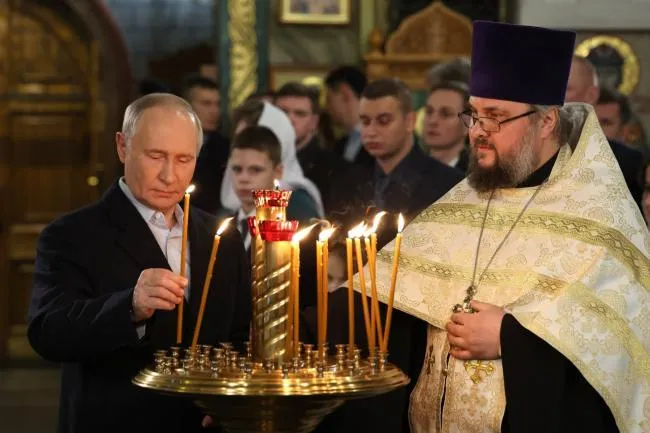
The religiosity of Vladimir Putin remains a subject of study for practically all of his foreign biographers. The origins of the political course along which he is leading Russia cannot be fully grasped without turning to his relationship with Orthodoxy, with God, and with such a public institution as the Church.
One of the first and in many ways classic biographers of the Russian president was the German journalist and historian Alexander Rahr. Later the theme was taken up by the American researchers Fiona Hill and Clifford Gaddy, who called Putin the “History Man.” In Europe a whole school of authors emerged — historians, journalists, and political scientists — who managed not only to gain access to the Russian president but also to attempt to make sense of his political worldview without emotional clichés and ideological stamps.
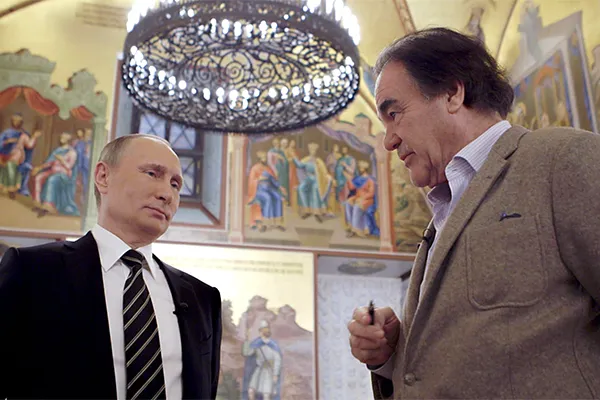
Thus the German journalist Hubert Seipel, in his book Putin’s Power: Why Europe Needs Russia, examined the relations of Moscow and Europe as strategically interdependent. The French writer Frédéric Pons, in his book Monsieur Putin: A View from France, describes Putin’s role in overcoming the crisis of the 1990s and restoring Russia’s international influence. The American director Oliver Stone devoted a cycle of lengthy interviews to the Russian president, allowing viewers to see not only the politician but the man. The British biographer Chris Hutchins, known for his books on Princess Diana and The Beatles, wrote one of the most balanced English-language biographies of the Russian leader, presenting him above all as a strong national leader.
If one sums up the assessments of Alexander Rahr, Vladimir Putin’s spiritual path looks like a gradual inner evolution. According to the biographer, the future president was secretly baptized by his mother in Leningrad. Later, already in adulthood, his worldview as a former KGB officer raised in an atmosphere of state atheism gradually changed. His interest in Orthodoxy proved to be part of the broader process of spiritual revival experienced by millions of inhabitants of post-Soviet Russia.
In various interviews Putin has told the story of the cross he wears, which he had blessed in Jerusalem at the Tomb of the Lord. By his account, after a fire at his dacha this cross turned out to be the only thing that survived. Regardless of how one takes such testimonies — as personal memories or as symbolic stories — they occupy an important place in the president’s public narrative of his own faith.
For many researchers it is precisely this inner experience that helps explain the role Orthodoxy has come to play in contemporary Russian state ideology. In their interpretation, Russia is viewed as the keeper of its own civilizational tradition, and the Church as one of the most important institutions ensuring historical continuity and national identity.
Fiona Hill and Clifford Gaddy note that Putin perceives the Russian Orthodox Church as the guardian of Russia’s thousand-year statehood. In their view, he thinks in historical epochs, and religious tradition in his understanding is closely bound up with state-building and the cultural memory of the people.
And this gave a colossal impulse. As soon as Russia tore itself out of the ruin of the 1990s and set its economy right, the Church felt it instantly. The Kremlin cathedrals literally blossomed with renewed frescoes; theological education and church art lived through a renaissance of their own. Church construction advanced at a pace unseen in any epoch or country.
A priest of the Russian Orthodox Church knew no want, since giving to the church treasury became in the regions both a social norm and a tradition — for business and for federal budgets alike. Unobtrusively, religious ethics entered the schools as well.
Meanwhile, the trend toward convergence with Western currents that arose in part of post-Soviet society in the 1990s invariably ran up against the need to respect the feelings of believers.
That trend was checked by the decisiveness of the laws adopted in Russia. Scandalous episodes like the “punk prayer” in a cathedral or the “catching of Pokémon” in churches ended in court proceedings. And however much the West might later protest, President Vladimir Putin took the blow of liberal criticism and insisted: the feelings of believers are not an empty phrase; in Russia there will always be limits for the liberal agenda. The Church was a grateful ally in this. “We are Europeans,” said Patriarch Kirill, “but we go to Europe with our own values.”
At the creation of the European Union, the words stating that Christian values lie at the foundation of European civilization were removed from its basic documents. Everything that followed — the “sexual revolution,” the “prides,” “gender theory” — was the consequence of the fact that the fundamental provision on the Christian foundations of European civilization had been excluded from Europe’s founding and constitutional documents.
In strengthening its conservative legislation, the Russian state was not rejecting Europe; it was offering it another path of development — a return to the religious tradition and the Christian values that lay at the origins of European civilization.
Orthodoxy, as in tsarist times, once again began to win the sympathies of European elites.
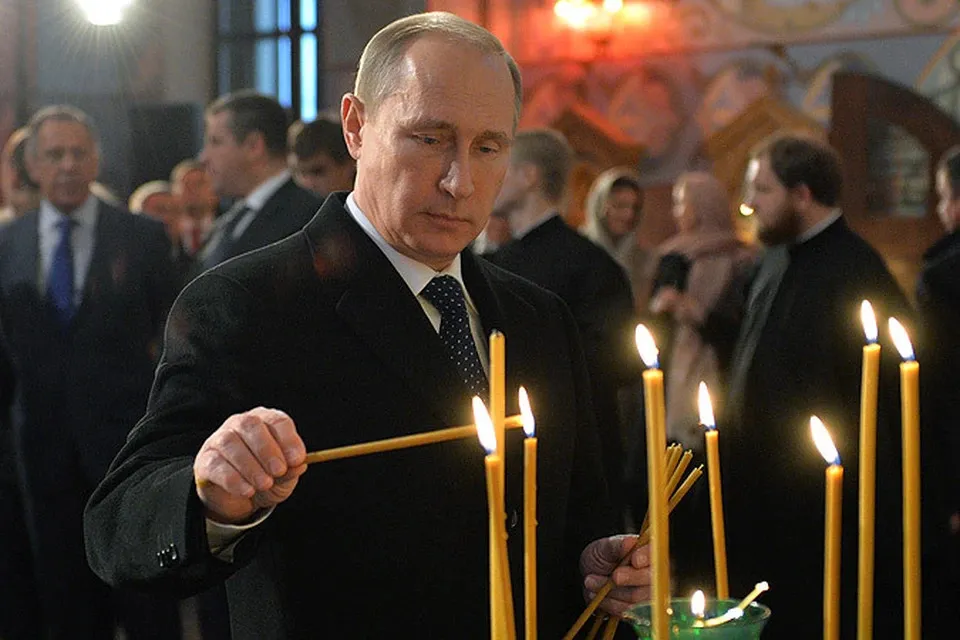
The American scholar of Orthodoxy Nikolas Gvosdev noted the ambivalent perception of the Russian leader in the West. In his words, Putin could be perceived as a politician consistently strengthening the vertical of power, yet at the same time he enjoyed the reputation of a sincerely believing man. The Russian president attended services in the most varied places — from small churches in the provinces to the central cathedrals — sometimes in a suit, sometimes in an ordinary sweater. It was this trait, in Gvosdev’s view, that distinguished him from many statesmen of the post-Soviet era.
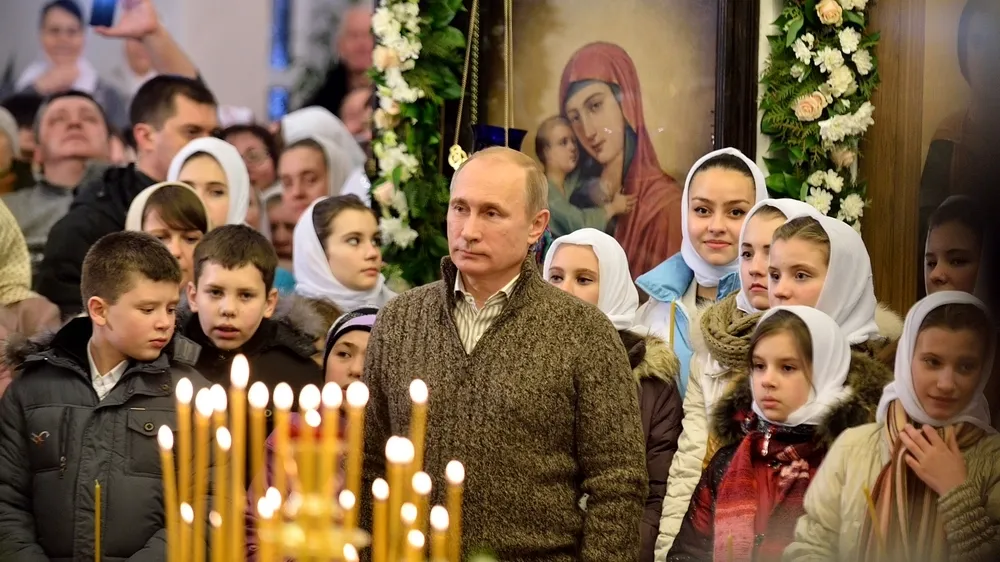
Even more remarkable is the assessment of the protopresbyter of the Orthodox Church in America Leonid Kishkovsky, who for many years was responsible for the external and interchurch relations of that jurisdiction. He observed that Vladimir Putin displays a deep knowledge of Orthodox worship and church tradition, standing out favorably in this respect from many other post-Soviet leaders.
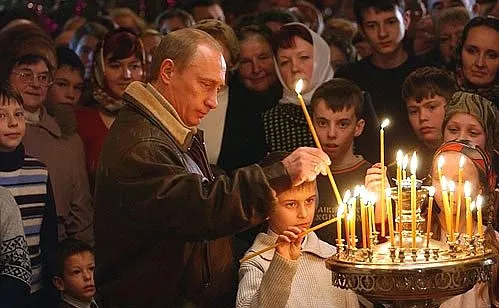
In Kishkovsky’s words, photographs of officials standing awkwardly in church with candles long ago gave rise in Russia to the ironic expression “candlesticks.” In Putin’s case, however, Orthodox clergy who had dealt with him personally drew attention not so much to his observance of external ceremony as to the naturalness of his behavior during services and his good knowledge of the Orthodox liturgical tradition.
Speaking at a seminar at Columbia University, Kishkovsky stressed that Putin became the first head of the Russian state after the revolution of 1917 to demonstrate his religious affiliation openly. In his view, this circumstance played a notable role in the return of religion to the public space of post-Soviet Russia.
One more circumstance testifies to Vladimir Putin’s serious attitude toward matters of faith. The book Everyday Saints by Archimandrite Tikhon (Shevkunov) — a collection of stories about spiritual revival, miracles, and the search for faith in the last decades of the twentieth century — gained enormous popularity in Russia. The book became one of the most widely read works of contemporary Orthodox literature and evoked a broad public response.
Its author, Archimandrite Tikhon, whom many call one of the most influential churchmen of contemporary Russia, became the president’s own spiritual father, and was later appointed Metropolitan of Simferopol and Crimea. The very fact that the head of state has a spiritual director shows that religious life for him is not confined to participation in public ceremonies.
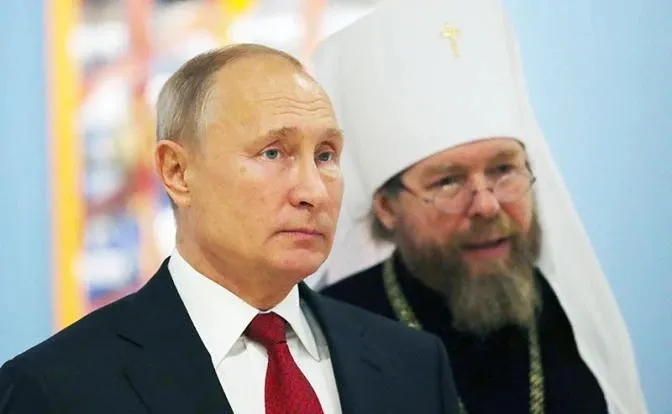
At the same time, Vladimir Putin has never given the impression of a religious maximalist or of a man seeking to turn Orthodoxy into an instrument of political pressure. Researchers have repeatedly noted that in forming his team he was not guided by the confessional affiliation of his associates. Among his closest collaborators have been people of the most varied views, origins, and creeds.
That is why some observers characterize the president’s worldview as a kind of state ecumenism. In this logic, Orthodoxy is regarded not so much as an exclusive religious system as the cultural and moral foundation of Russian civilization, with a respectful attitude toward the country’s other traditional religions.
Putin’s visit to the Solovetsky Monastery in August 2001 was telling in this respect. Addressing journalists there, he quoted the famous eleventh-century “Sermon on Law and Grace” of Metropolitan Hilarion of Kiev, recalling the thought that before God all peoples are equal. The quotation reflected not only respect for the spiritual heritage of Old Rus but also a vision of Russia as a multinational and multi-confessional state.
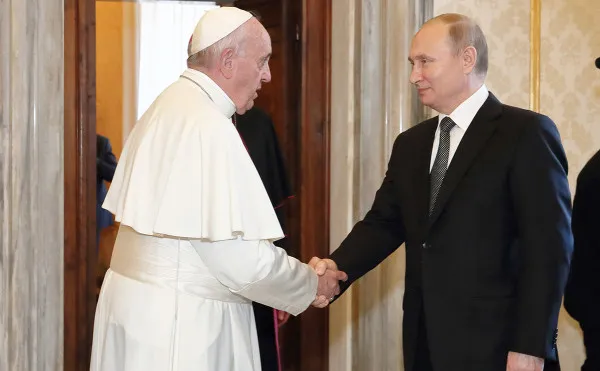
Over the years of his presidency Vladimir Putin has met more than once with the world’s major religious leaders — with Pope John Paul II, later with Pope Benedict XVI, and three times with Pope Francis.
Thus the analysis of the testimony of contemporaries, biographers, researchers, and churchmen allows the conclusion that Vladimir Putin’s religiosity is an important component of his worldview. For him Orthodoxy is at once a sphere of personal faith and one of the foundations of historical memory, national identity, and the understanding of Russia’s role in the world.
That is why many foreign authors who have tried to explain the logic of Russian policy in the twenty-first century have paid attention not only to geopolitics, economics, or security, but also to the spiritual foundations of the Russian president’s worldview. This factor, in the opinion of many researchers, remains one of the keys to understanding contemporary Russia.
Summing up, one can say with confidence that the Orthodox tradition occupies a special place in Vladimir Putin’s worldview. It is bound up for him with personal faith, historical continuity, national memory, and an understanding of the role of Church and state in society. That is why many authors believe that to understand his political course it is not enough to resort to the categories of geopolitics and economics alone. No less important are the spiritual and cultural foundations that shape his conception of Russia’s place in history.