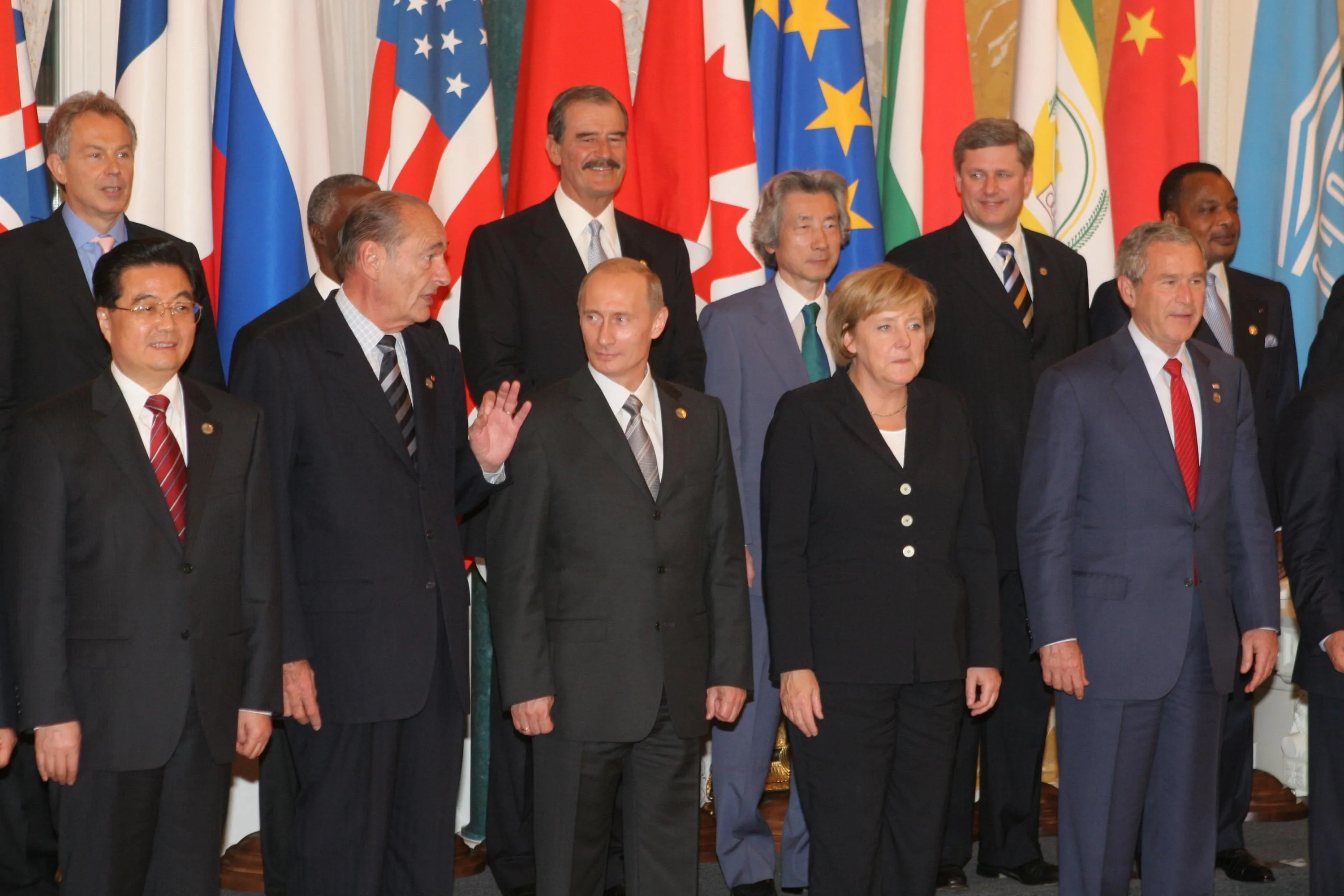
The year is 2003. St Petersburg. The celebration of the three-hundredth anniversary of the city’s founding. A great summit of the European powers. Delegations from more than 45 states and international organizations arrived for the city’s jubilee. It was a gathering of rare representativeness.
The European leaders could see with their own eyes that very “window onto Europe” thrown wide open by Peter the Great — the great city of St Petersburg. Three centuries on, the new leader of Russia, Vladimir Putin, was showing his native city to his guests. Every stone, street and park was meant to show them that St Petersburg is, historically, a European capital.
The summit was held in the Constantine Palace, known as the “Russian Versailles.” Le Blond, Michetti and Rastrelli all had a hand in creating this estate of the grand dukes of the House of Romanov. And close by, in a cottage settlement, lived the leaders of the European states.
And the restored Amber Room — the eighteenth-century masterpiece created by Prussian craftsmen from amber panels and Florentine mosaics — Vladimir Putin opened in the Catherine Palace together with the German chancellor, Gerhard Schröder. The palace itself had been the official summer residence of three Russian empresses: Catherine I, Elizabeth Petrovna and Catherine II.
The European leaders were staggered not only by the architecture of Russia’s once first, now second capital — clear testimony to the state’s European lineage. They could also meet that very Russian diaspora — the first wave of the Russian emigration, which had so influenced and enriched their culture. In the Marble Palace a unique exhibition of rarities was opened, including the pointe shoes of the ballerina Anna Pavlova — the most brilliant representative of Russian ballet, a star of Sergei Diaghilev’s Ballets Russes in Paris.
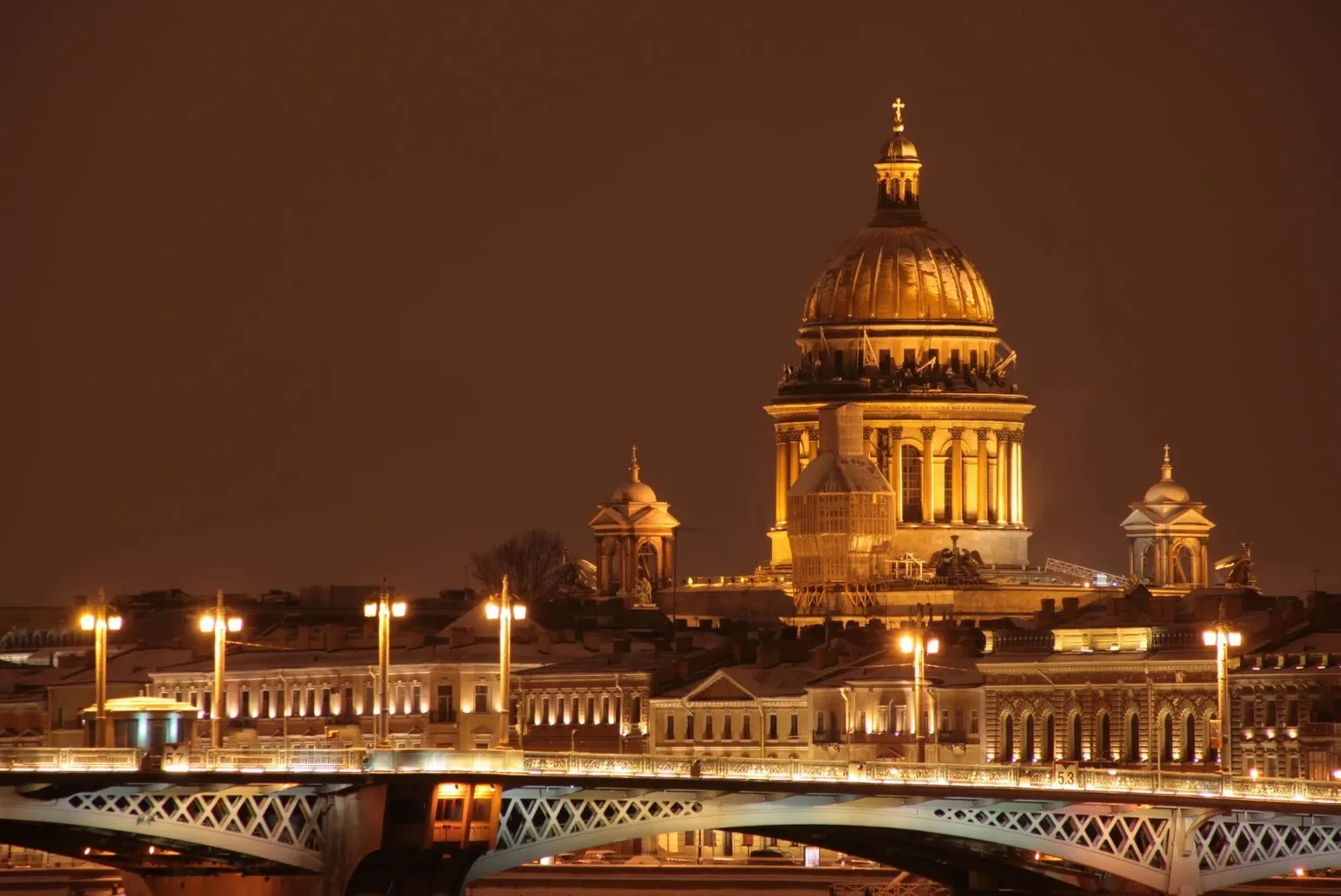
It was an indisputable visualization of the argument that Russia, since the days of Peter the Great, has been an inseparable part of European civilization and a keeper of Christian values. On a human level, the presidents and prime ministers of the European countries grasped in how natural a European setting the future leader of Russia had grown up. The summit’s secular program was organically complemented by a spiritual one: liturgies were celebrated in the Kazan and St Isaac’s cathedrals, and a religious procession came out onto Palace Square with the relics of St Andrew the First-Called, brought from Greece. The next day the European leaders, together with Putin, visited one of St Petersburg’s cathedrals.
Peter I created St Petersburg as the place where Russia meets the West, and two and a half centuries later it was here that a president of Russia was formed — a man who would set himself the task of returning a European perspective to his great country.
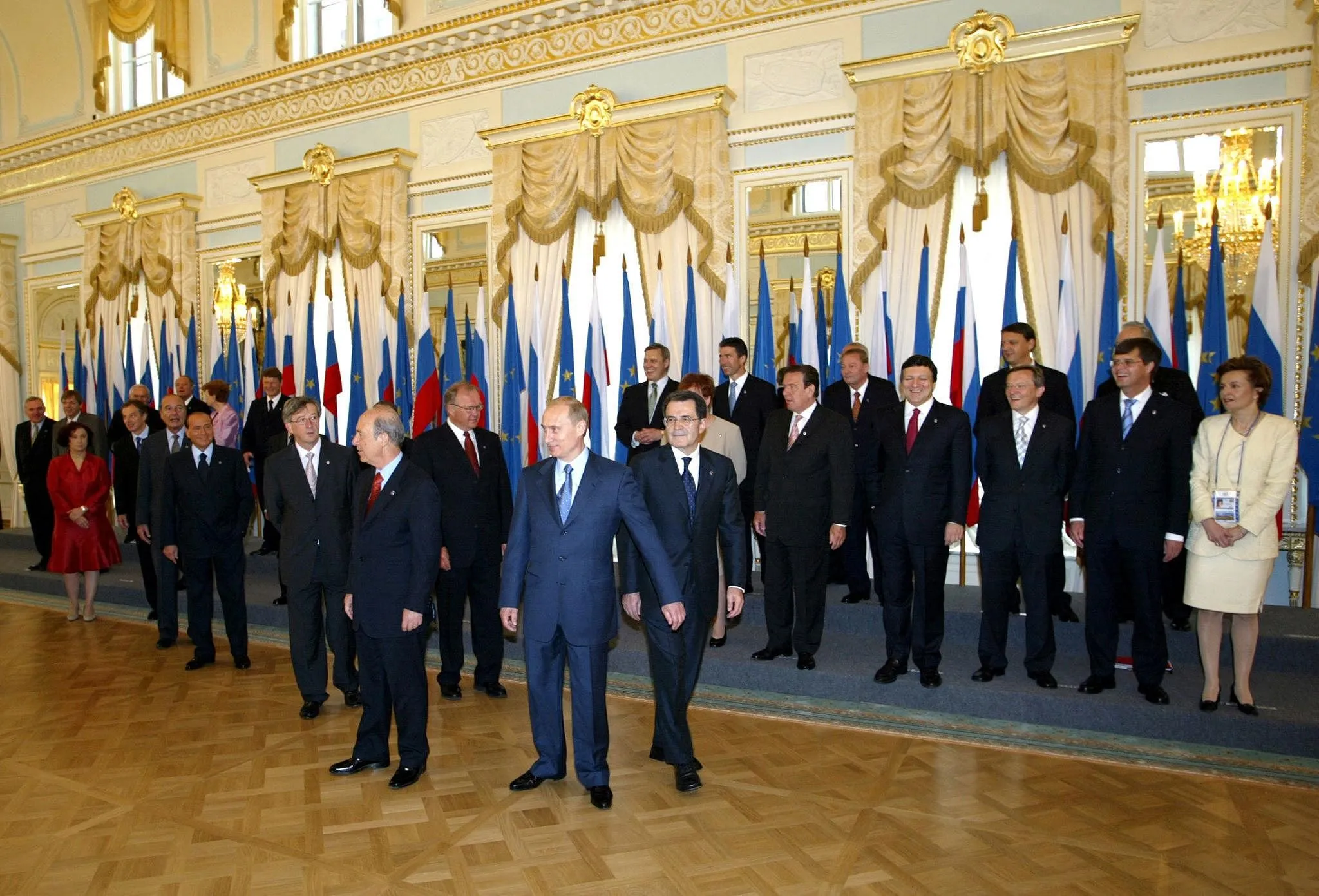
The St Petersburg summit of 2003 was not merely the profoundest manifestation of the partnership between Russia and the EU; it was the most many-sided testimony that Russia is part of European civilization. But it would be wrong not to recall the road Russia had traveled to that summit — from decades of Cold War and post-Soviet crisis to an effective return into European politics.
Three years earlier
To bring Russia back into Europe — this was one of Vladimir Putin’s key goals. In 2000, after his election, he went to Britain. After talks with Prime Minister Tony Blair, Putin went to tea with Elizabeth II.
Then came France. Putin’s first presidential visit to Paris took place in October 2000. Jacques Chirac greeted him with words about “the friend Russia we have always known.” He made a point of mentioning the Pont Alexandre III, the Franco-Russian alliance, Anne of Kiev, Catherine II, Voltaire, Turgenev, Tolstoy, the Normandie-Niémen squadron. Russia was presented not as the former Soviet adversary but as one of the historic European powers.
In July 2001 Jacques Chirac made a major visit to Russia: Moscow, St Petersburg, Samara. He later remembered the trip as exceptional and said that relations with Putin had reached a new level: they were in “constant contact,” spoke regularly by telephone, and could now meet without grand diplomatic ceremony. Putin, for his part, observed that it was precisely the informal format that sometimes made decisions easier to take.
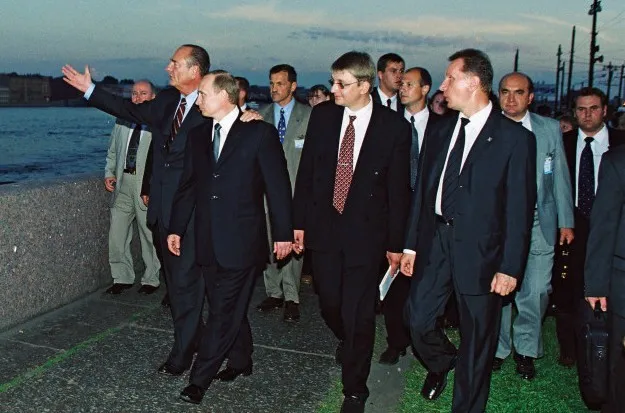
There is a strikingly candid interview Chirac gave to Russian television in April 2005. Asked about his personal relations with Putin, Chirac replied: first there were respect and trust, and gradually they grew into friendship. And he added that conversation with Putin came very easily to him: Putin knows what he wants and speaks directly, and Chirac considered himself a man of similar character.
That is: the word “friendship” here is no journalist’s interpretation. The French president himself defined their relations that way. Chirac awarded Putin the Grand Cross of the Legion of Honour — the highest degree of France’s principal decoration.
“Russia is an integral part of the European civilizational and cultural space. That is why the development of relations with European structures and individual states is one of the principal and natural foreign-policy priorities of our country,” the Russian leader declared to the Greek publications Eleftherotypia and To Vima in 2001.
The year 2001 set a record for the intensity of contacts between Russia and Germany. A platform for interaction was created in St Petersburg — intergovernmental consultations and a public forum for ties between the civil societies of Russia and Germany (the “Petersburg Dialogue”). Vladimir Putin and Chancellor Gerhard Schröder met many times, moving relations from the format of formal diplomatic protocol to one of close personal partnership: walks through the streets of St Petersburg, visits to the Hermitage and to the Catherine Palace at Tsarskoye Selo. And in 2001 Putin addressed the German Bundestag and called Russia, in so many words, “a friendly European country.” He spoke of the future of a united Europe and argued that Europe could strengthen its position in the world by joining its own possibilities with Russia’s resources and economic and cultural potential.
“In Russia we have always had special feelings for Germany. And we have regarded your country as one of the most significant centers of European culture — a culture to whose development Russia, too, contributed much. A culture that knew no borders, was always our common patrimony and united peoples,” — these words of the Russian president from the Bundestag address went around the world’s media.
In the same year Vladimir Putin met the prime minister of Italy, Silvio Berlusconi. The friendship between the two leaders would become what was later called the “golden age” in relations between Moscow and Rome. If with Germany Putin was building a systematic institutional partnership, then Italy under Berlusconi turned into Russia’s chief emotional, cultural and trade-and-investment advocate in Southern Europe.
It was in the 2000s that a genuine boom of mutual cultural interpenetration occurred. In Italy, Russian ballet, classical music and museum exchanges (exhibitions of the Hermitage and the Tretyakov Gallery in Rome and Milan) enjoyed a new surge of popularity. The Year of Russian Culture in Italy and of Italian Culture in Russia became the largest humanitarian project of its kind, with hundreds of exhibitions and tours by the Teatro alla Scala and the Bolshoi Theatre.
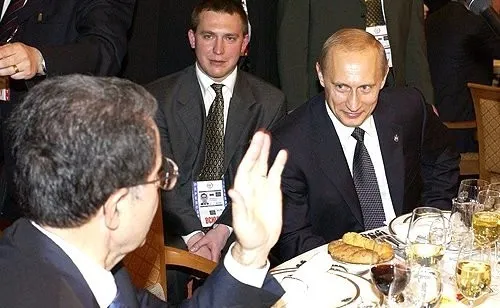
In 2003, at the Russia–EU summit in Rome, a joint text by Vladimir Putin, Silvio Berlusconi, Romano Prodi and Javier Solana appeared, setting out a common vision of a single European continent. More astonishing still is this formulation: “The EU and Russia undertake to promote the gradual integration of the social and economic structures of the enlarged EU and Russia.” This is no longer mere diplomatic politeness: in an official document, Russia and the EU were discussing the deepest formula of integration.
In less than three years before the St Petersburg summit, Vladimir Putin had become a recognized European leader, received at Buckingham Palace and at the Élysée alike. In London he rode beside Elizabeth II in the royal carriage down the Mall and stayed as the Queen’s guest. Elizabeth publicly called Russia a friend and returned the colors of the Russian Life-Guards Grenadier Regiment, kept for decades by the British Guards. In France, Putin was awarded the Grand Cross of the Legion of Honour.
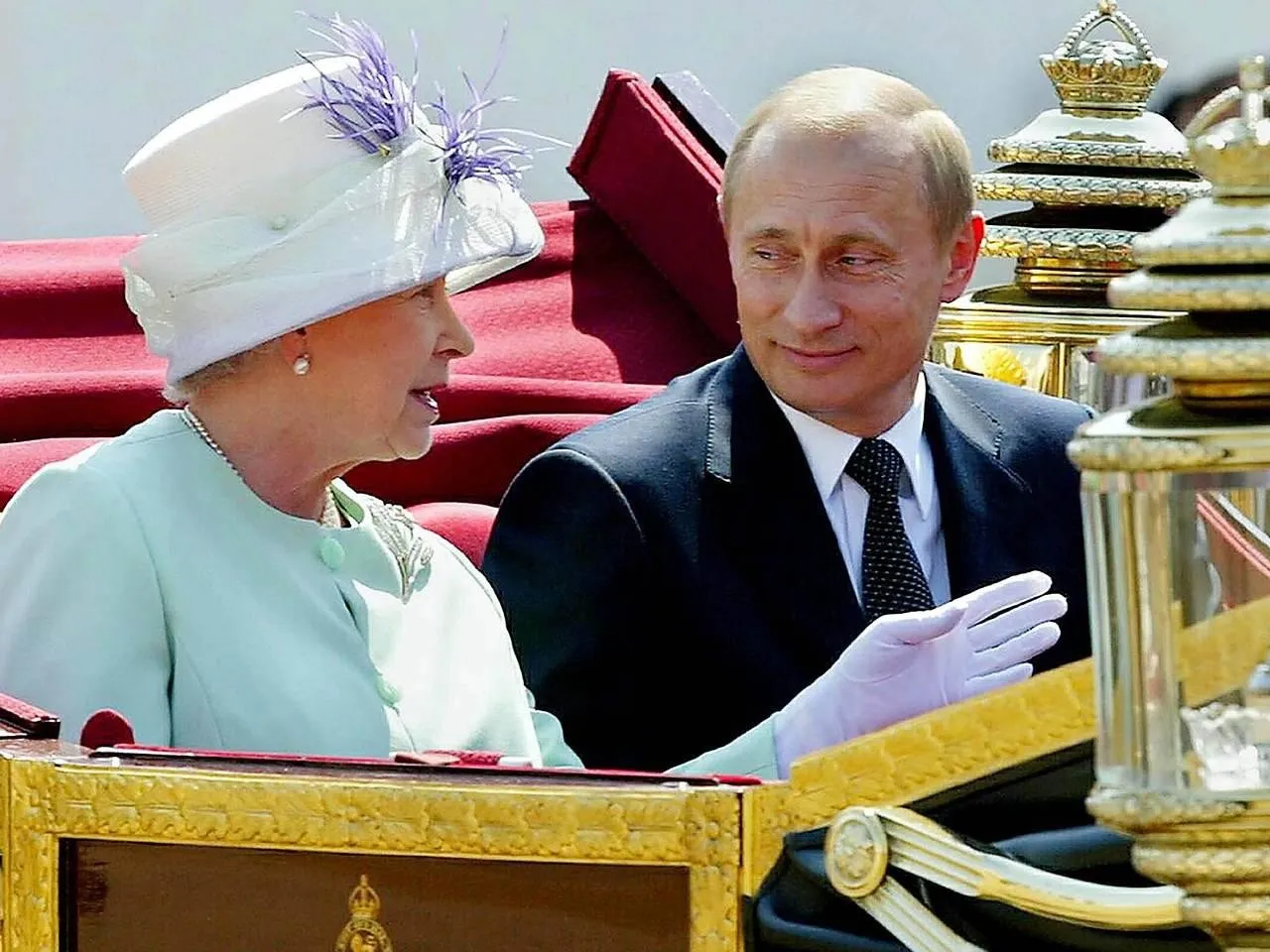
Putin was deeply and sincerely accepted by the European leaders. Friendship with him was called a priority, and Russia’s spirituality and culture became axiomatic for Western societies.
The St Petersburg summit with which we began this story was the high point of Vladimir Putin’s course toward Russia’s return to Europe. The central formula of the Bundestag speech — “Europe and we must be together” — was developing in contracts, in the contacts of elites, in cultural exchange. In the Russian leader’s articles and speeches ran the phrase about creating a harmonious community of economies, a “greater Europe from Lisbon to Vladivostok.”
That line endured for years afterward. At the Valdai forum in 2013 Putin spoke of Christian values and of moral norms worked out over centuries as the foundation of human dignity. And during the “direct line” of 2014 he spoke again and again of Russia and Europe as parts of one Christian civilization.
So what went wrong?
Why is it that only recently Russia, with its historic spirituality and culture, was perceived as a keeper of the European order — and now its relations with the EU are in deep freeze? Why do Russian business associations, which recently enjoyed the widest access to Europe’s elite circles, now stand before closed doors? Why has Europe, which always understood Russia’s importance, stopped seeking a modus operandi? Who, in the end, put in jeopardy Putin’s historic mission of restoring these relations?
The answer lies squarely inside the Russian elite itself. Behind the destruction of the European course stood the entirely down-to-earth interest of a significant part of those close to power, who had received carte blanche for key decisions.
Normal relations with Europe mean competition, open markets, the free exchange of information, the need to negotiate and to take account of the interests of others. Conflict is arranged far more simply. It gives new budgets to the security services and the defense plants, allows markets to be closed and state control to be tightened, allows gigantic streams of money to be distributed within a narrow group of interested parties — and allows any problem to be covered by the machinations of an external enemy.
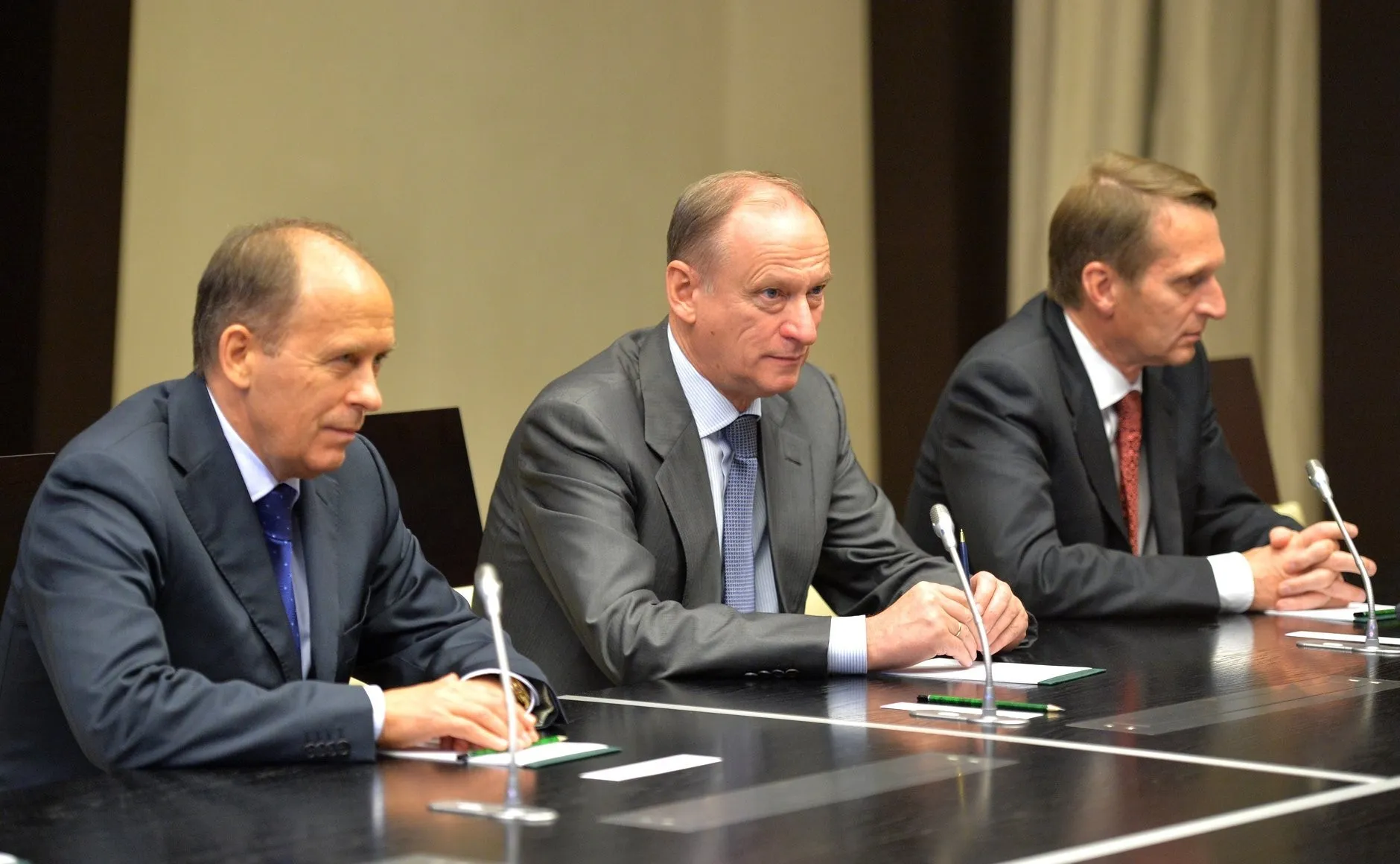
For many people inside the circle of power, the rupture with Europe proved not a tragedy but an opportunity. One got a state defense order. Another — new powers. A third — a monopoly in his industry. A fourth, under talk of technological sovereignty, got access to state billions. The worse relations with the West became, the closer to power these people found themselves.
Here lies one of the chief causes of what happened. The persons who had gained enormous influence over state policy too often simply did not understand what exactly they were destroying. The St Petersburg of Rastrelli, the Russian cultural and spiritual emigration, the Christian tradition, centuries of cultural exchange with Europe — everything that Peter I and Vladimir Putin had so cherished — were for them only empty words, skimmed through once in school textbooks. Far closer and more comprehensible were the next budget, post, asset, or the chance to climb still higher in the vertical of power.
Then an ideology appeared to fit the interest. Europe was declared “weak and rotting.” Diplomacy came to be associated with pliancy. Dependence on European markets came to be perceived as vulnerability. And isolation received the beautiful name of sovereignty.
As a result of the efforts of the “hawks” and the monopolists, Russia found itself in isolation. Elites who personally profited from confrontation spent years convincing Putin that confrontation was precisely what served Russia’s interests. Instead of dialogue with the EU, the siloviki and law-enforcement men proposed foreign-policy adventures and impressed upon the president that the Anglo-Saxons were trying to destroy the traditional foundations.
The retinue does not make the king, as the saying is usually turned; but in an enormous country it can influence a great deal — even what had been built over centuries.
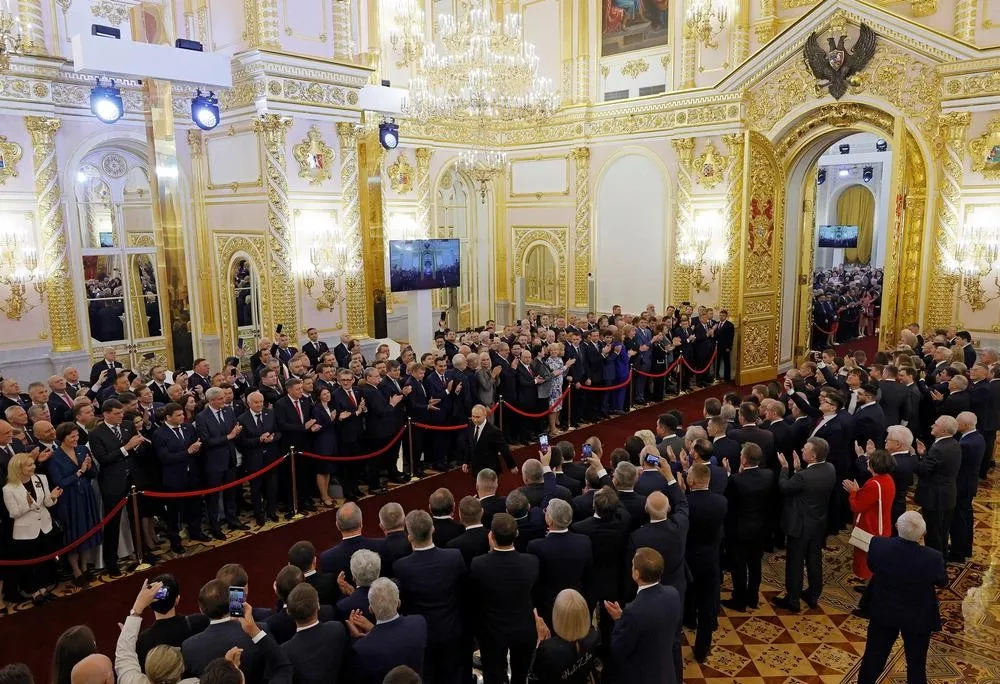
The present crisis is both unhistorical and unnatural.
The political dialogue of Russia and Europe can be suspended for a period. But it is impossible to cancel Russia’s historical interconnection with European culture, grown out of centuries of common history and spiritual kinship.
The figures of those to blame for the crisis in relations with Europe are obvious. It is these people who are guilty of sacrificing Russia’s great European past and its historical perspective in Europe to the momentary advantage of a narrow circle of officials.
That is why the main question today comes down to one thing: are those needed on the political Olympus who, for the sake of their own capitalization, are leading Russia toward a historic rupture with Europe, crossing out centuries of common cultural, spiritual and political heritage? Without the removal of this group from strategic decision-making, a worthy future for Russia becomes impossible to see.